[ Blog · For Brands · 6 min read ]
By Sefa Yamak
Product Photography Lighting: How We Build a Still Life for Jewellery and Brands
How our team lights product and jewellery still-life photography: one light, textured backgrounds, mirrors as tools and catalog consistency, step by step.
A still life is three decisions made in the right order: the light, the surface, and the shadow. Everything else — the lens, the camera, the retouching — comes after. When a product image feels expensive, it is almost never because of the gear. It is because someone decided where the shadow falls before pressing the shutter. That is the whole craft, and it is learnable.
At PAM Istanbul we shoot product campaigns as a team — photographer, producer, set stylist, retoucher — and jewellery has taught us more about light than any other subject. A gold ring is a tiny mirror with opinions. If you can light a ring, you can light a bottle of serum, a sneaker, a phone. In this piece we walk through how we actually build these sets, using our jewellery still-life work as the running example.
One light is enough
The most common beginner instinct is to add lights. Our instinct, after years of sets, is to remove them. Most of our jewellery frames are lit with a single source, and the only real question is whether that source is hard or soft.
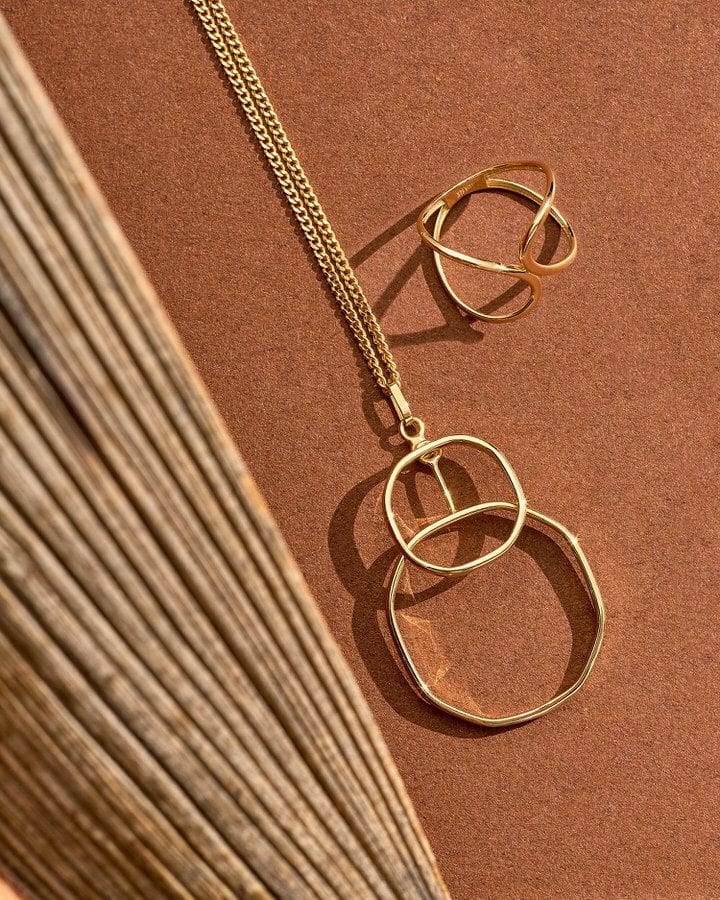
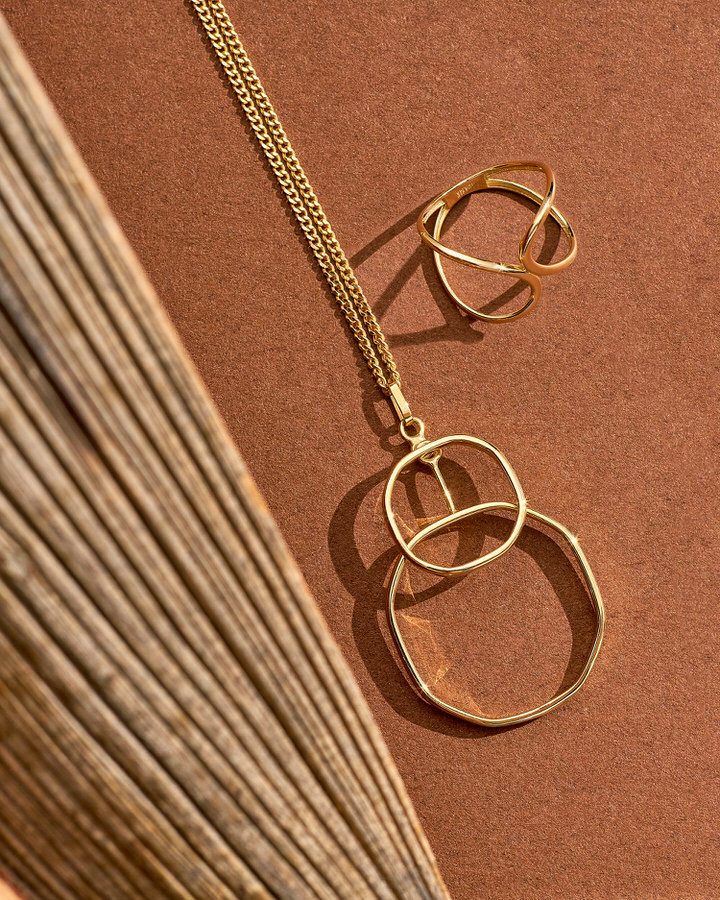
Hard light — a bare bulb, a fresnel, or simply direct sun through a window — gives you crisp shadow edges, high micro-contrast and specular sparkle. On the gold pieces above, the hard directional light is what makes the texture of the paper visible and the shadow of the necklace graphic instead of mushy. Hard light is honest: it shows every scratch, every fingerprint, every dust particle. That is why teams fear it, and why it looks premium when the product can survive it.
Soft light — a large diffusion frame or softbox close to the set — wraps around the object, opens the shadows and flatters imperfect surfaces. It is the safe choice for skincare bottles and matte packaging, the kind of work we do for brands like Bioderma. Our rule of thumb: hard light sells texture and drama, soft light sells cleanliness and trust. Decide which one the brand needs before you plug anything in.
The background is half the image
A product floating on seamless white is a catalog requirement, not a photograph. When the brief allows atmosphere, the surface under the product does as much work as the light above it.
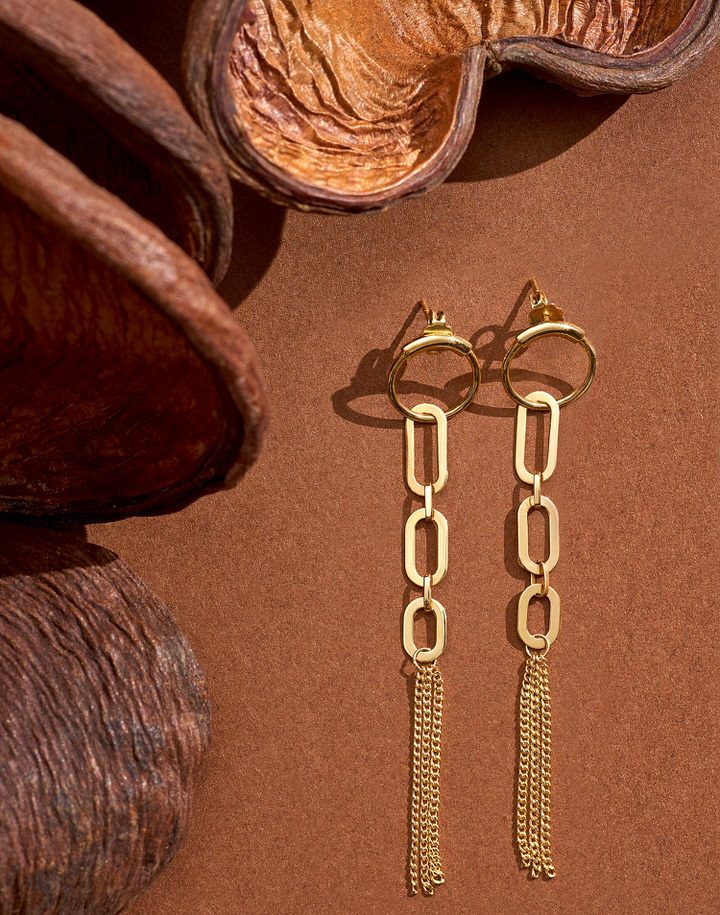
For the Runda gold jewellery campaign we built sets from textured paper in warm browns, pleated and folded wood, dried grasses and seed pods. None of it is expensive material — the value is in the pairing. Gold against warm kraft paper stays tonal and quiet; gold against a cool grey would fight. We keep a props shelf in the studio stocked with things collected from nature: stones, branches, dried botanicals. Organic texture gives a machined product something to be different from, and that contrast is what your eye reads as "crafted".
One practical habit: light the background first, empty. Watch how the texture responds to the angle of the light. A raking hard light across paper reveals its grain; frontal light kills it. Only when the surface looks right do we place the product.
Reflections are a tool, not an enemy
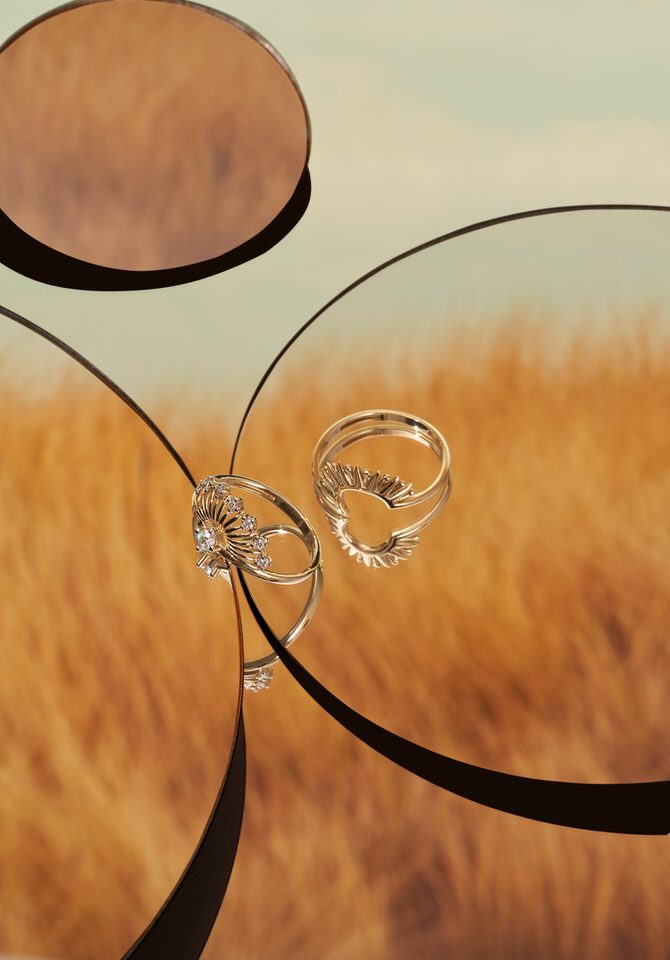
Every tutorial teaches you to fight reflections. We prefer to hire them. In the mirror composition above, the round mirrors do two jobs: they lift the rings off the surface visually, and they pull the dried-grass backdrop into the frame as a reflected layer. One set, two depths.
The technique that makes reflective products manageable is simple: a shiny surface does not show light, it shows whatever the light is bouncing off. So instead of lighting the ring, we light the things the ring reflects — a white card here, a black flag there. Move a white card ten centimetres and a dead facet comes alive. This is slow, deliberate work, and it is exactly why jewellery is shot by teams: one person watches the tethered screen while another walks a card around the set millimetre by millimetre.
Black flags matter as much as white cards. A chrome or polished-gold surface with no dark reflection reads as flat and cheap. The dark edges are what give metal its shape.
Consistency across a catalog
One beautiful frame is a portfolio piece. Forty consistent frames are a campaign. This is where product photography stops being about taste and becomes about production discipline — and it is the part e-commerce brands feel immediately when it is missing.
On multi-product shoots for brands like realme and Hotiç, we lock the variables before the first product touches the set: camera height and distance are taped, the light position is marked on the floor, white balance is set with a grey card and never touched again, and a reference frame stays open on the tether screen for every new product to be matched against. We keep a written set sheet — light modifier, power, distances, surface — so that if a product needs a reshoot two weeks later, the frame drops into the grid seamlessly.
Consistency is a team output. The photographer holds the light, the digital operator holds the reference, the producer holds the shot list. No single pair of eyes can guard all three across a long day.
From still life to campaign
A strong still-life system is not the end product; it is the foundation a campaign stands on. The same textured-paper world we built for jewellery stills can extend into motion, into model-worn shots, into social crops — because the light logic and the palette were defined once, deliberately. When a brand comes to us with a product, the conversation is never just "photograph this". It is: what world does this object live in, and how does light behave in that world? Answer that once, and every asset after it gets easier.
FAQ
What kind of light works best for jewellery photography?
Usually one controlled source, and more often hard than you would expect. Hard directional light gives metal its sparkle and surfaces their texture; we then shape the reflections with white cards and black flags rather than adding more lights. Soft light alone tends to make gold look flat and plasticky.
How do you avoid the camera showing up in reflective products?
Shoot at a slight angle instead of dead-on, use a longer lens from further away so the camera occupies less of the reflection, and place white or black cards so the product reflects them instead of the room. For extreme cases we shoot through a small hole in a large diffusion or card surface, so the reflection shows a clean plane with only a tiny dark dot where the lens is — easily retouched.
Natural light or studio light for product photography?
Both can produce professional results; the difference is repeatability. Window light is beautiful and free, but it changes by the hour, which makes catalogs inconsistent. For one-off editorial stills, natural light is a legitimate choice. For any shoot with more than a handful of products, we use studio light so frame one and frame forty match.
How do you keep 100 products looking consistent?
By treating it as production, not photography. We fix camera position, light position, power and white balance before the first shot, document everything on a set sheet, and match every new product against a reference frame on the tethered screen. One person shoots, another checks consistency — the second pair of eyes is the actual secret.
Related serviceShooting and production in Istanbul with PAM Istanbul — see the work or send a brief.