[ Blog · Photography & Fine Art · 6 min read ]
By Sefa Yamak
What black and white takes away
Color is information. A portrait is usually about one thing, and most of the time the color is telling you about something else.
I work in both color and black and white, and people sometimes ask how I decide. The honest answer is that I do not decide so much as notice what the picture is about, and then ask whether the color is helping or talking over it.
Color is information. That is its gift and its problem. A red turban, a green sari, the gold on a forehead at dawn — these can be the whole reason a photograph exists, and to strip them out would be to throw away the subject. The India work is in color because in India the color is not decoration; it is the language people speak with cloth.
But a great deal of the time the color is telling you about something the portrait is not about. It tells you the wall was a particular green, the sweater a particular blue, the light a particular hour. All true, all real, and all in the way. When I find myself looking at a face and being distracted by the colour of the things around it, that is the picture that wants to be black and white.
Black and white does not add drama, whatever people say. It removes a layer. It takes away the answer to the question "what colour was everything" so that the only questions left are the ones that matter: where is the light coming from, what is this person thinking, what are the hands doing. Tone, shape, gaze. The grammar of a face.
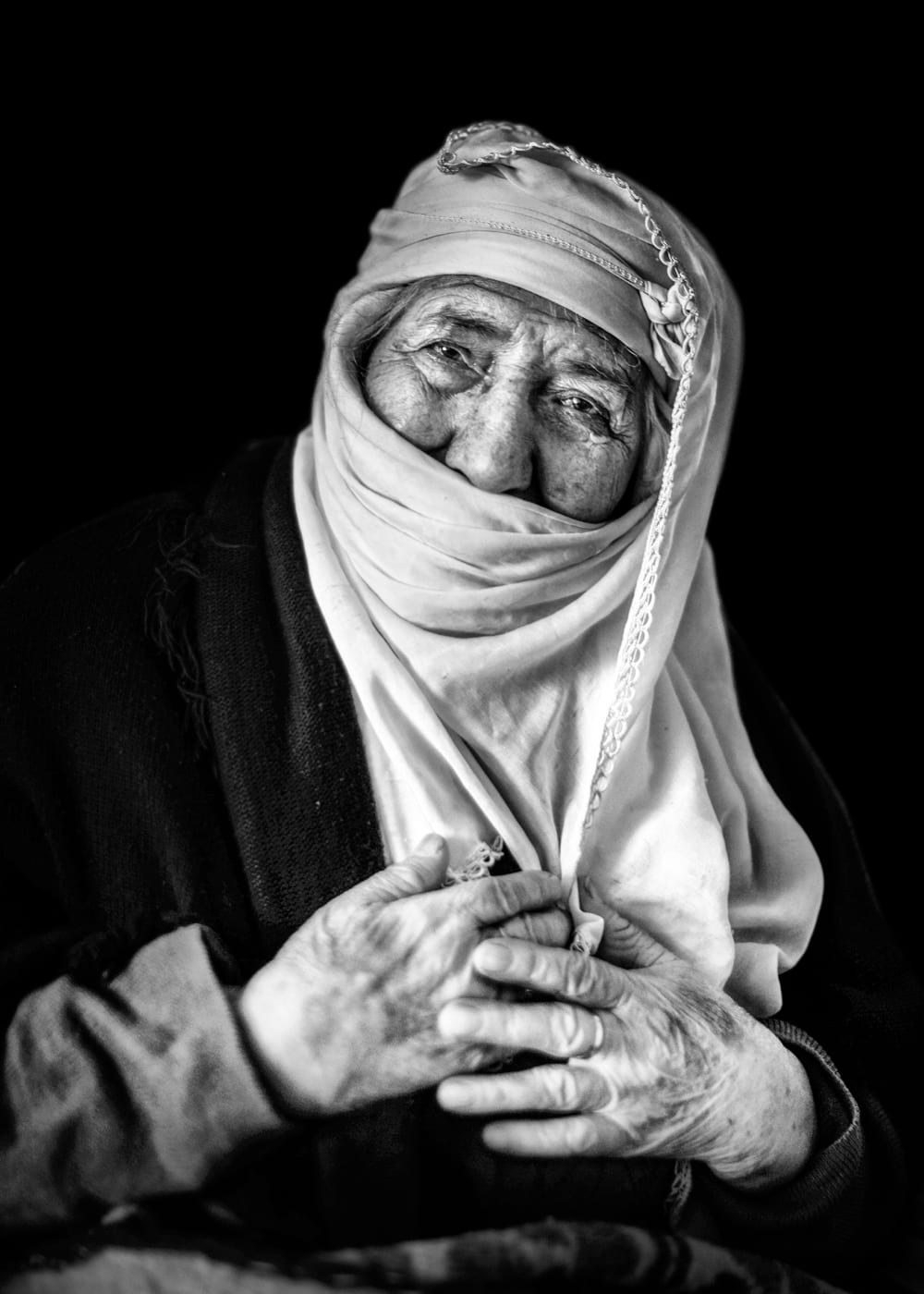
There is a portrait in the Anatolia series of an old woman with her hands folded at her throat, made indoors against a dark cloth. In colour it was a picture of a brown cardigan and a cream scarf. In black and white it became a picture of a pair of hands that had worked for eighty years. Same frame, same second. One version was about wool. The other was about a life.
So I do not have a rule. I have a question, and I ask it of every frame: if I take the colour away, do I lose the subject or do I find it? The answer tells me what the photograph wanted to be all along.